fastai - Lesson 8 - Deep Learning for Coders (2020)
Notes taken while watching the Deep Learning for Coders (2020) - Lesson 8 video
Lex Toumbourou ·
Notes taken while watching the Lesson 8 - Deep Learning for Coders (2020) video.
!pip install git+https://github.com/fastai/fastai.git &> /dev/null
00:00:00 - Intro and NLP Review
- In Lesson 1, we create a sentiment classifier, but haven't looked at what's going on behind the scene.
00:01:31 - Language models in NLP
- The pretrained model we used for the IMDB sentiment analysis, was a pretrained language model.
- One example of a language model: trying to predict next word of text.
- To be able to this, a language needs to have a good understanding of language.
- You can download pretrained language models through various Model Zoos.
00:04:36 - Review of lesson 1.
- We downloaded a pretrained model and fine tuned it:
from fastai.text.all import *

dls = TextDataLoaders.from_folder(untar_data(URLs.IMDB), valid='test')
learn = text_classifier_learner(dls, AWD_LSTM, drop_mult=0.5, metrics=accuracy)
learn.fine_tune(4, 1e-2)
| epoch | train_loss | valid_loss | accuracy | time |
|---|---|---|---|---|
| 0 | 0.449429 | 0.379644 | 0.831000 | 02:17 |
| epoch | train_loss | valid_loss | accuracy | time |
|---|---|---|---|---|
| 0 | 0.297342 | 0.359466 | 0.860680 | 04:14 |
| 1 | 0.251144 | 0.222691 | 0.910480 | 04:16 |
| 2 | 0.198196 | 0.195068 | 0.922920 | 04:14 |
| 3 | 0.146078 | 0.191531 | 0.928360 | 04:15 |
00:05:08 - Improving results by creating a domain-specific language model
- One trick to use is start with a Wikitext language model, then improve it by creating a domain-specific language model. In this example, an IMDb language model.
- Will learn IMDb specific words.
00:05:58 - Building a language model from scratch
Sentences can be different lengths. Documents can be very long.
We already looked at using categorical variables as independant variables:
- Make list of all possible levels of the categorical variable (vocab)
- Replace each level with index in vocab
- Create embedding matrix containing a row for each level
- Use embedding matric as first layer of nn
We can almost do the same thing with text.
- Create a list of all words to generate vocab
- Only question is how to use a sequence?
Independant variable is sequence of words from first to 2nd last.
Dependant variable is 2nd word down to last.
When we create vocab, a lot of words will be already in embedding matrix
- May be new ones: informal slang, words not in Wikipedia etc.
For words in Wikipedia, we will use the pretrained embedding vector.
For new words, we will create a new random row.
List of steps:
- Tokenisation - convert into a list of words (characters or substrings)
- Numericalisation - make a list of unique words in the vocab. Convert each word into a number by looking up the index in vocab
- Language model data loader - fastai has
LMDataLoaderwhich handles creating dependent varible offset from independent by one token. - Language model - need a special model that can handle sequences of arbitrary length.
00:10:27 - Tokenisation
- Converting a text into a list of words.
- Questions to ask: What to do with punctuation? How to deal with words like "don't"? Long medical or chemical words? etc
- 3 common approaches:
- Word-based approached: used by default in English. Split on spaces and applies some language specific rules to separate parts of meaning. Like turning "don't" into "do n't". Punctuation marks also split into separate tokens.
- Subword based: split words into smaller parts, based on common occurring substrings. "occasion" might be tokenised as "o c ca sion"
- Character-based: split sentence into individual characters.
00:12:19 - Word tokenisation
- fastai doesn't invent its own tokenisers, but provide consistent interface to a range of tokenisers.
- Start by getting all text files from IMDB dataset:
from fastai.text.all import *
path = untar_data(URLs.IMDB)
files = get_text_files(path, folders=['train', 'test', 'unsup'])
- Can get and read first one:
txt = files[0].open().read(); txt[:75]
'Jiang Xian uses the complex backstory of Ling Ling and Mao Daobing to study'
- Default English word tokeniser called spaCy.
spacy = WordTokenizer()
toks = first(spacy([txt]))
print(coll_repr(toks, 30))
(#143) ['Jiang','Xian','uses','the','complex','backstory','of','Ling','Ling','and','Mao','Daobing','to','study','Mao',"'s",'"','cultural','revolution','"','(','1966','-','1976',')','at','the','village','level','.'...]
- Another example:
first(spacy(['The U.S. dollar $1 is $1.00']))
(#8) ['The','U.S.','dollar','$','1','is','$','1.00']
- Fastai adds some additional functionality. It adds some "special tokens" that start with character
xxxxbosindicates start of new text or "beginning of stream".xxmaj- next word beings with capital.xxunkindicates next word is unknown
tkn = Tokenizer(spacy)
coll_repr(tkn('© Fast.ai www.fast.ai/INDEX'), 31)
"(#11) ['xxbos','©','xxmaj','fast.ai','xxrep','3','w','.fast.ai','/','xxup','index']"
00:17:38 - Subword tokeniser
- In Chinese, they don't use spaces. Instead, they use subword tokenisation.
- Look at corpus of documents and find most commonly occurring groups of letters: they become vocab.
txts = L(o.open().read() for o in files[:2000])
- This function
setupis used to prepare or train some transformations. In this example, it trains on a subset of the corpus
def subword(sz):
    sp = SubwordTokenizer(vocab_sz=sz)
    sp.setup(txts)
    return ' '.join(first(sp([txt]))[:40])
subword(1000)
'▁J i ang ▁ X ian ▁us es ▁the ▁comp le x ▁back st or y ▁of ▁L ing ▁L ing ▁and ▁Ma o ▁Da o b ing ▁to ▁st u d y ▁Ma o \' s ▁" c ul'
- With a larger vocab, most common English words end up in vocab itself
subword(10000)
'▁J ian g ▁X ian ▁uses ▁the ▁complex ▁back story ▁of ▁L ing ▁L ing ▁and ▁Ma o ▁Da ob ing ▁to ▁study ▁Ma o \' s ▁" cul t ural ▁revolution " ▁( 1966 - 1 9 7 6'
- Jeremy predicts that subword will be the most popular form of tokenisation.
00:21:21 - Question: how can we determine if pretrained model is suitable for downstream task? If there's limited vocab overlap, should we create a language model from scratch
- In same language, Wikitext usually works well.
- If you were using Genomic sequences, or Greek then you would likely need a domain-specific language model.
00:23:25 - Numericalization
- After splitting into tokens, the next step is numericalization.
toks200 = txts[:200].map(tkn)
toks200[0]
(#158) ['xxbos','xxmaj','jiang','xxmaj','xian','uses','the','complex','backstory','of'...]
- Can then pass into
setupto createvocab
num = Numericalize()
num.setup(toks200)
coll_repr(num.vocab, 20)
"(#2152) ['xxunk','xxpad','xxbos','xxeos','xxfld','xxrep','xxwrep','xxup','xxmaj','the',',','.','and','a','of','to','is','in','it','i'...]"
- The tokens are in order of frequency.
- Defaults:
min_freq=3- minimum frequency required.max_vocab=60000- limit the size of the embedding matrix
- Defaults:
- Can now call
numas if it was a function:
nums = num(toks)[:20]; nums
TensorText([   0,    0, 1268,    9, 1269,    0,   14,    0,    0,   12,    0,    0,
          15, 1270,    0,   22,   24,    0,  795,   24])
- Can convert back by indexing into vocab:
' '.join(num.vocab[o] for o in nums)
'xxunk xxunk uses the complex xxunk of xxunk xxunk and xxunk xxunk to study xxunk \'s " xxunk revolution "'
00:25:43 - Putting texts into batches for language model
- Items in a mini-batch need to be the same size to be stacked in Tensor.
- With images, we resize them all to a consistent size.
- How do we do it with text?
- We could break into contiguous blocks that match our batch size. Here's an example of a batch size of 6:
stream = "In this chapter, we will go back over the example of classifying movie reviews we studied in chapter 1 and dig deeper under the surface. First we will look at the processing steps necessary to convert text into numbers and how to customize it. By doing this, we'll have another example of the PreProcessor used in the data block API.\nThen we will study how we build a language model and train it for a while."
tokens = tkn(stream)
bs,seq_len = 6,15
d_tokens = np.array([tokens[i*seq_len:(i+1)*seq_len] for i in range(bs)])
df = pd.DataFrame(d_tokens)
df
| 0 | 1 | 2 | 3 | 4 | 5 | 6 | 7 | 8 | 9 | 10 | 11 | 12 | 13 | 14 | |
|---|---|---|---|---|---|---|---|---|---|---|---|---|---|---|---|
| 0 | xxbos | xxmaj | in | this | chapter | , | we | will | go | back | over | the | example | of | classifying |
| 1 | movie | reviews | we | studied | in | chapter | 1 | and | dig | deeper | under | the | surface | . | xxmaj |
| 2 | first | we | will | look | at | the | processing | steps | necessary | to | convert | text | into | numbers | and |
| 3 | how | to | customize | it | . | xxmaj | by | doing | this | , | we | 'll | have | another | example |
| 4 | of | the | preprocessor | used | in | the | data | block | xxup | api | . | \n | xxmaj | then | we |
| 5 | will | study | how | we | build | a | language | model | and | train | it | for | a | while | . |
- That won't scale to a giant corpus, so we have to divide into subarrays with a fixed sequence length.
- Let's try a sequence length of 5:
bs,seq_len = 6,5
d_tokens = np.array([tokens[i*15:i*15+seq_len] for i in range(bs)])
df = pd.DataFrame(d_tokens)
df
| 0 | 1 | 2 | 3 | 4 | |
|---|---|---|---|---|---|
| 0 | xxbos | xxmaj | in | this | chapter |
| 1 | movie | reviews | we | studied | in |
| 2 | first | we | will | look | at |
| 3 | how | to | customize | it | . |
| 4 | of | the | preprocessor | used | in |
| 5 | will | study | how | we | build |
- Then the next batch:
#hide_input
bs,seq_len = 6,5
d_tokens = np.array([tokens[i*15+seq_len:i*15+2*seq_len] for i in range(bs)])
df = pd.DataFrame(d_tokens)
df
| 0 | 1 | 2 | 3 | 4 | |
|---|---|---|---|---|---|
| 0 | , | we | will | go | back |
| 1 | chapter | 1 | and | dig | deeper |
| 2 | the | processing | steps | necessary | to |
| 3 | xxmaj | by | doing | this | , |
| 4 | the | data | block | xxup | api |
| 5 | a | language | model | and | train |
- And so on.
00:29:24 - LMDataLoader
- Don't have to do these steps yourself,
LMDataLoaderin fastai handles it for you.
nums200 = toks200.map(num)
dl = LMDataLoader(nums200)
x, y = first(dl)
x.shape, y.shape
(torch.Size([64, 72]), torch.Size([64, 72]))
- 64 is batch size and 72 is sequence size.
- Can examine the first 20 tokens of independent variable:
' '.join(num.vocab[o] for o in x[0][:20])
'xxbos xxmaj xxunk xxmaj xxunk uses the complex xxunk of xxmaj xxunk xxmaj xxunk and xxmaj xxunk xxmaj xxunk to'
- then dependent variable, which is the same thing offset by one token:
' '.join(num.vocab[o] for o in y[0][:20])
'xxmaj xxunk xxmaj xxunk uses the complex xxunk of xxmaj xxunk xxmaj xxunk and xxmaj xxunk xxmaj xxunk to study'
00:31:07 - Creating language model with DataBlock
- In the DataBlock instance, we're using a
TextBlockfrom the block argument.- Passing in a class method, allows the tokenisation to be cached.
get_imdb = partial(get_text_files, folders=['train', 'test', 'unsup'])

dls_lm = DataBlock(
    blocks=TextBlock.from_folder(path, is_lm=True),
    get_items=get_imdb, splitter=RandomSplitter(0.1)
).dataloaders(path, path=path, bs=128, seq_len=80)
- Note the items are text items from folders.
- We can then call show_batch:
dls_lm.show_batch(max_n=2)
| text | text_ | |
|---|---|---|
| 0 | xxbos xxmaj this movie is so xxup stupid ! i mean .. why does xxmaj liam xxmaj neeson take this woman so seriously , having only heard her say 3 xxup words ! xxmaj when they found her in the woods , they should xxunk have committed her to psychiatric hospital to try and make her a real human being . xxmaj just to see xxmaj jodie " hey - see how stupid i look " xxmaj foster dance around | xxmaj this movie is so xxup stupid ! i mean .. why does xxmaj liam xxmaj neeson take this woman so seriously , having only heard her say 3 xxup words ! xxmaj when they found her in the woods , they should xxunk have committed her to psychiatric hospital to try and make her a real human being . xxmaj just to see xxmaj jodie " hey - see how stupid i look " xxmaj foster dance around chanting |
| 1 | tracking down vehicles that may have entered the crime scene from camera - visible locations adjacent to the crime scene as part of developing clues . \n\n * xxmaj in xxmaj england , driving is on the left . xxmaj the director goes out of his way to have the car at the crime scene park on the right , several meters away from the flower kiosk , when it could have easily parked immediately behind , or even on | down vehicles that may have entered the crime scene from camera - visible locations adjacent to the crime scene as part of developing clues . \n\n * xxmaj in xxmaj england , driving is on the left . xxmaj the director goes out of his way to have the car at the crime scene park on the right , several meters away from the flower kiosk , when it could have easily parked immediately behind , or even on the |
00:33:23 - Fine tuning a language model
- Fine tuning language model creates a learning which learns to predict next word of music review.
AWD_LSTMis the architecture.drop_multis amount of Dropout (covered later in the course).
learn = language_model_learner(
    dls_lm, AWD_LSTM, drop_mult=0.3,
    metrics=[accuracy, Perplexity()],
    path='/kaggle/working'
).to_fp16()
learn.fit_one_cycle(1, 2e-2)
| epoch | train_loss | valid_loss | accuracy | perplexity | time |
|---|---|---|---|---|---|
| 0 | 4.006212 | 3.899826 | 0.300805 | 49.393833 | 27:45 |
00:35:07 - Saving and loading models
- Can use
learn.saveto save intermediary results:
learn.save('1epoch')
Path('/kaggle/working/models/1epoch.pth')
And load with learn.load:
learn.load('1epoch')
<fastai.text.learner.LMLearner at 0x7fa49e0a2e10>
- Can then finetune after unfreezing:
learn.unfreeze()
learn.fit_one_cycle(10, 2e-3)
| epoch | train_loss | valid_loss | accuracy | perplexity | time |
|---|---|---|---|---|---|
| 0 | 3.763982 | 3.759459 | 0.316605 | 42.925179 | 30:04 |
| 1 | 3.684646 | 3.699707 | 0.323066 | 40.435436 | 30:15 |
| 2 | 3.623890 | 3.654301 | 0.328286 | 38.640499 | 30:13 |
| 3 | 3.564344 | 3.620885 | 0.332433 | 37.370613 | 30:22 |
| 4 | 3.501577 | 3.598828 | 0.335188 | 36.555359 | 30:30 |
| 5 | 3.427867 | 3.579867 | 0.337651 | 35.868767 | 30:05 |
| 6 | 3.362838 | 3.575086 | 0.339170 | 35.697678 | 30:37 |
| 7 | 3.302284 | 3.569533 | 0.340268 | 35.499996 | 30:19 |
| 8 | 3.239792 | 3.574208 | 0.340490 | 35.666363 | 30:12 |
| 9 | 3.215606 | 3.578157 | 0.340285 | 35.807476 | 30:14 |
- We can then save just the encoder.
- Encoder is all of the model that isn't the final layer.
learn.save_encoder('finetuned')
00:36:44 - Question: Do language models attempt to provide meaning?
- Language model do tend to get good at understanding nuances of languages.
00:37:56 - Text generation (next notebook)
00:37:56 - Text generation
- Firstly, to load the model from the previous notebook:
from fastai.text.all import *
path = untar_data(URLs.IMDB)

get_imdb = partial(get_text_files, folders=['train', 'test', 'unsup'])

dls_lm = DataBlock(
    blocks=TextBlock.from_folder(path, is_lm=True),
    get_items=get_imdb, splitter=RandomSplitter(0.1)
).dataloaders(path, path=path, bs=128, seq_len=80)

learn = language_model_learner(
    dls_lm, AWD_LSTM, drop_mult=0.3,
    metrics=[accuracy, Perplexity()],
    path='/kaggle/working'
).to_fp16()
learn.load_encoder('/kaggle/input/lesson-8/models/finetuned')
<fastai.text.learner.LMLearner at 0x7f374aed6bd0>
- Then make some predictions using a short sentence as a prompt:
TEXT = "I liked this movie because"
N_WORDS = 40
N_SENTENCES = 2
preds = [learn.predict(TEXT, N_WORDS, temperature=0.75)
         for _ in range(N_SENTENCES)]
print("\n".join(preds))
i liked this movie because there were n't any twists or turns and was never dull . But the acting was pretty good considering everything else . The characters were believable and believable . Tom Sizemore and Emily Dafoe
i liked this movie because of its relatively low budget . The special effects are n't bad either -- except for an exaggerated facial expression .

 But now for the sudden appearance of these aliens . In fact , these aliens
TEXT = "I thought this movie would be more like Jaws but it was "
N_WORDS = 40
N_SENTENCES = 2

preds = [
    learn.predict(TEXT, N_WORDS, temperature=0.75)
    for _ in range(N_SENTENCES)
]

print("\n".join(preds))
i thought this movie would be more like Jaws but it was n't a rip off . It was mostly about middle spectacular men searching for boat and finding each other with their own basic twists and turns . This was written and directed by Al Pacino who
i thought this movie would be more like Jaws but it was more like a remake of Jaws than a remake or update .

 Although they did n't compare this to Jaws 3 because it still has n't changed the storyline since it was made .
- There are better ways to do language generation, but this tells us that the model has learned something.
00:39:51 - Creating classification model
- Create another DataBlock. This time, we provide a vocab from the language by passing in a vocab (
dls_lm.vocab) toTextBlock.from_folder - Also aren't passing
is_lm=Trueinstead passingCategoryBlockas the dataset has a sentiment label.
dls_clas = DataBlock(
    blocks=(TextBlock.from_folder(path, vocab=dls_lm.vocab), CategoryBlock),
    get_y=parent_label,
    get_items=partial(get_text_files, folders=['train', 'test']),
    splitter=GrandparentSplitter(valid_name='test')
).dataloaders(path, path=path, bs=128, seq_len=72)
dls_clas.show_batch(max_n=3)
| text | category | |
|---|---|---|
| 0 | xxbos xxmaj match 1 : xxmaj tag xxmaj team xxmaj table xxmaj match xxmaj bubba xxmaj ray and xxmaj spike xxmaj dudley vs xxmaj eddie xxmaj guerrero and xxmaj chris xxmaj benoit xxmaj bubba xxmaj ray and xxmaj spike xxmaj dudley started things off with a xxmaj tag xxmaj team xxmaj table xxmaj match against xxmaj eddie xxmaj guerrero and xxmaj chris xxmaj benoit . xxmaj according to the rules of the match , both opponents have to go through tables in order to get the win . xxmaj benoit and xxmaj guerrero heated up early on by taking turns hammering first xxmaj spike and then xxmaj bubba xxmaj ray . a xxmaj german xxunk by xxmaj benoit to xxmaj bubba took the wind out of the xxmaj dudley brother . xxmaj spike tried to help his brother , but the referee restrained him while xxmaj benoit and xxmaj guerrero | pos |
| 1 | xxbos xxmaj titanic directed by xxmaj james xxmaj cameron presents a fictional love story on the historical setting of the xxmaj titanic . xxmaj the plot is simple , xxunk , or not for those who love plots that twist and turn and keep you in suspense . xxmaj the end of the movie can be figured out within minutes of the start of the film , but the love story is an interesting one , however . xxmaj kate xxmaj winslett is wonderful as xxmaj rose , an aristocratic young lady betrothed by xxmaj cal ( billy xxmaj zane ) . xxmaj early on the voyage xxmaj rose meets xxmaj jack ( leonardo dicaprio ) , a lower class artist on his way to xxmaj america after winning his ticket aboard xxmaj titanic in a poker game . xxmaj if he wants something , he goes and gets it | pos |
| 2 | xxbos xxmaj warning : xxmaj does contain spoilers . \n\n xxmaj open xxmaj your xxmaj eyes \n\n xxmaj if you have not seen this film and plan on doing so , just stop reading here and take my word for it . xxmaj you have to see this film . i have seen it four times so far and i still have n't made up my mind as to what exactly happened in the film . xxmaj that is all i am going to say because if you have not seen this film , then stop reading right now . \n\n xxmaj if you are still reading then i am going to pose some questions to you and maybe if anyone has any answers you can email me and let me know what you think . \n\n i remember my xxmaj grade 11 xxmaj english teacher quite well . xxmaj | pos |
00:41:04 - Question: Do tokeniser do stemming or lemitisation, or is that outdated?
- Stemming and lemitisation is not part of tokenisation.
- We have stems for a reason, so we don't remove them.
00:42:21 - Handling different sequence lengths
- With the language model, we can concat all documents together and split into substrings based on batch size. This ensures each mini-batch is the same size (batch_size x sequence length).
- We can't do that with shorter movie reviews. Each movie needs to be associated with dependant variable.
spacy = WordTokenizer()
tkn = Tokenizer(spacy)
files = get_text_files(path, folders=['train', 'test', 'unsup'])
txts = L(o.open().read() for o in files[:2000])

toks200 = txts[:200].map(tkn)
toks200[0]

num = Numericalize()
num.setup(toks200)
nums_samp = toks200[:10].map(num)
- Can look at the lengths, and notice that they're all quite different:
nums_samp.map(len)
(#10) [158,319,181,193,114,145,260,146,252,295]
- What we need to do is add padding.
- Add special
xxpadtoken to each sequence to make them all the size of the largest sequence.
- Add special
- fastai also tries to get similarly sized sentences together to try to minimise padding.
- All of this happens when you call
TextBlock.from_folder
00:45:30 - Create and fine tune classifier
learn = text_classifier_learner(
    dls_clas, AWD_LSTM, drop_mult=0.5, metrics=accuracy).to_fp16()
- Now we can load the encoder:
learn = learn.load_encoder('/kaggle/input/lesson-8/models/finetuned')
learn.fit_one_cycle(1, 2e-2)
| epoch | train_loss | valid_loss | accuracy | time |
|---|---|---|---|---|
| 0 | 0.269207 | 0.195298 | 0.924400 | 01:46 |
- The results are similar to the first classifier, but took under 2 minutes to train.
- In NLP, it's better to unfreeze a layer at time:
learn.freeze_to(-2)
learn.fit_one_cycle(1, slice(1e-2/(2.6**4), 1e-2))
| epoch | train_loss | valid_loss | accuracy | time |
|---|---|---|---|---|
| 0 | 0.253995 | 0.181843 | 0.931440 | 01:58 |
- Can unfreeze a few more layers:
learn.freeze_to(-3)
learn.fit_one_cycle(1, slice(5e-3/(2.6**4), 5e-3))
| epoch | train_loss | valid_loss | accuracy | time |
|---|---|---|---|---|
| 0 | 0.211313 | 0.166533 | 0.936720 | 02:42 |
- Then the whole model:
learn.unfreeze()
learn.fit_one_cycle(2, slice(1e-3/(2.6**4), 1e-3))
| epoch | train_loss | valid_loss | accuracy | time |
|---|---|---|---|---|
| 0 | 0.173864 | 0.164418 | 0.938880 | 03:18 |
| 1 | 0.170001 | 0.163286 | 0.939640 | 03:17 |
- Can get to 95.1% accuracy by training on all texts backwards.
00:48:54 - Question: how can a model trained to predict next word work on a different domain like sentiment?
- To be able to predict next word of sentence, you have to know a lot about language and the world. That knowledge transfers to other domains.
00:51:00 - Question: how do you do data augmentation on text?
- One approach is to pass text through a translator and back again.
- Some goods ideas in this paper: Unsupervised Data Augmentation for Consistency Training.
00:51:52 - Ethics and risks of text generation
- FCC asked for comments about a proposal to repeal Net Neutrality. Turned out less than 800k of 22M comments where unique.
- What would happen if someone created a million Twitter bots so that 99% of the content were fake deep learning bots?
00:56:22 - Language model from scratch
- Going to learn how a recurrent neural network works.
00:56:52 - Question: are there model interpretabilty tools for language models?
- There are some, but won't be covered in this part of the course.
00:58:11 - Preparing the dataset: tokenisation and numericalisation
- Jeremy created a dataset called human numbers that contains first 10k numbers written out in English.
- Seems very few people create datasets, even though it's not particularly hard.
from fastai.text.all import *
from fastcore.foundation import L

path = untar_data(URLs.HUMAN_NUMBERS)
Path.BASE_PATH = path
path.ls()
(#2) [Path('valid.txt'),Path('train.txt')]
lines = L()
with open(path/'train.txt') as f:
    lines += L(*f.readlines())
with open(path/'valid.txt') as f:
    lines += L(*f.readlines())

lines
(#9998) ['one \n','two \n','three \n','four \n','five \n','six \n','seven \n','eight \n','nine \n','ten \n'...]
- Concat them together and put a dot between them for tokenising.
text = ' . '.join([l.strip() for l in lines])
text[:100]
'one . two . three . four . five . six . seven . eight . nine . ten . eleven . twelve . thirteen . fo'
- Tokenise by splitting on spaces:
tokens = L(text.split(' '))
tokens[100:110]
(#10) ['.','forty','two','.','forty','three','.','forty','four','.']
- Create a vocab by getting unique tokens:
vocab = L(tokens).unique()
vocab, len(vocab)
((#30) ['one','.','two','three','four','five','six','seven','eight','nine'...],
 30)
- Convert tokens into numbers by looking up index of each word:
word2idx = {w: i for i,w in enumerate(vocab)}
nums = L(word2idx[i] for i in tokens)
tokens, nums
((#63095) ['one','.','two','.','three','.','four','.','five','.'...],
 (#63095) [0,1,2,1,3,1,4,1,5,1...])
- That gives us a small easy dataset for building a language model.
01:01:31 - Language model from scratch
- Create a independent and dependent pair: first 3 words are input, next is dependent.
L((tokens[i:i+3], tokens[i+3]) for i in range(0, len(tokens)-4, 3))
(#21031) [(['one', '.', 'two'], '.'),(['.', 'three', '.'], 'four'),(['four', '.', 'five'], '.'),(['.', 'six', '.'], 'seven'),(['seven', '.', 'eight'], '.'),(['.', 'nine', '.'], 'ten'),(['ten', '.', 'eleven'], '.'),(['.', 'twelve', '.'], 'thirteen'),(['thirteen', '.', 'fourteen'], '.'),(['.', 'fifteen', '.'], 'sixteen')...]
- Same thing numericalised:
seqs = L((tensor(nums[i:i+3]), nums[i+3]) for i in range(0, len(nums)-4, 3))
seqs
(#21031) [(tensor([0, 1, 2]), 1),(tensor([1, 3, 1]), 4),(tensor([4, 1, 5]), 1),(tensor([1, 6, 1]), 7),(tensor([7, 1, 8]), 1),(tensor([1, 9, 1]), 10),(tensor([10, 1, 11]), 1),(tensor([ 1, 12, 1]), 13),(tensor([13, 1, 14]), 1),(tensor([ 1, 15, 1]), 16)...]
- Can batch those with a
DataLoaderobject- Take first 80% as training, last 20% as validation.
bs = 64
cut = int(len(seqs) * 0.8)
dls = DataLoaders.from_dsets(seqs[:cut], seqs[:cut], bs=64, shuffle=False)
01:03:35 - Simple Language model
- 3 layer neural network.
- One linear layer that is reused 3 times.
- Each time the result is added to the embedding.
class LMModel(Module):
    def __init__(self, vocab_sz, n_hidden):
        self.input2hidden = nn.Embedding(vocab_sz, n_hidden)
        self.hidden2hidden = nn.Linear(n_hidden, n_hidden)
        self.hidden2output = nn.Linear(n_hidden, vocab_sz)

    def forward(self, x):
        hidden = self.input2hidden(x[:,0])
        hidden = F.relu(self.hidden2hidden(hidden))

        hidden = hidden + self.input2hidden(x[:,1])
        hidden = F.relu(self.hidden2hidden(hidden))

        hidden = hidden + self.input2hidden(x[:,2])
        hidden = F.relu(self.hidden2hidden(hidden))

        return self.hidden2output(hidden)
01:04:49 - Question: can you speed up fine-tuning the NLP model?
- Do something else while you wait or leave overnight.
01:05:44 - Simple Language model cont.
- 2 interesting happening:
- Some of the inputs are being fed into later layers, instead of just the first.
- The model is reusing hidden state throughout layers.
learn = Learner(dls, LMModel(len(vocab), 64), loss_func=F.cross_entropy, metrics=accuracy)
learn.fit_one_cycle(4, 1e-3)
| epoch | train_loss | valid_loss | accuracy | time |
|---|---|---|---|---|
| 0 | 1.800355 | 1.929378 | 0.462197 | 00:03 |
| 1 | 1.364388 | 1.685311 | 0.466120 | 00:02 |
| 2 | 1.399541 | 1.464157 | 0.490787 | 00:03 |
| 3 | 1.362921 | 1.412893 | 0.495007 | 00:03 |
- We can find out if that accuracy is good by making a simple model that predicts most common token:
c = Counter(tokens[cut:])
mc = c.most_common(5)
mc
[('thousand', 7104),
 ('.', 7103),
 ('hundred', 6405),
 ('nine', 2440),
 ('eight', 2344)]
mc[0][1]/len(tokens[cut:])
0.15353028894988222
01:14:41 - Recurrent neural network
- We can refactor in Python using a for loop.
- Note that
hidden = 0is being broadcast into the hidden state.
- Note that
class LMModel2(Module):
    def __init__(self, vocab_sz, n_hidden):
        self.input2hidden = nn.Embedding(vocab_sz, n_hidden)
        self.hidden2hidden = nn.Linear(n_hidden, n_hidden)
        self.hidden2output = nn.Linear(n_hidden, vocab_sz)

    def forward(self, x):
        hidden = 0.

        for i in range(3):
            hidden = hidden + self.input2hidden(x[:,i])
            hidden = F.relu(self.hidden2hidden(hidden))

        return self.hidden2output(hidden)
learn = Learner(dls, LMModel2(len(vocab), 64), loss_func=F.cross_entropy, metrics=accuracy)
learn.fit_one_cycle(4, 1e-3)
| epoch | train_loss | valid_loss | accuracy | time |
|---|---|---|---|---|
| 0 | 1.827151 | 1.976822 | 0.457739 | 00:02 |
| 1 | 1.383131 | 1.667376 | 0.468141 | 00:03 |
| 2 | 1.398363 | 1.497497 | 0.490252 | 00:03 |
| 3 | 1.382042 | 1.432224 | 0.490965 | 00:03 |
- That's what a Recurrent Neural Network is!
01:18:39 - Improving the RNN
- Note that we're setting the previous state to 0.
- However, the hidden state from sequence to sequence contains useful information.
- We can rewrite to maintain state of RNN.
class LMModel3(Module):
    def __init__(self, vocab_sz, n_hidden):
        self.input2hidden = nn.Embedding(vocab_sz, n_hidden)
        self.hidden2hidden = nn.Linear(n_hidden, n_hidden)
        self.hidden2output = nn.Linear(n_hidden, vocab_sz)
        self.hidden = 0.


    def forward(self, x):
        for i in range(3):
            self.hidden = self.hidden + self.input2hidden(x[:,i])
            self.hidden = F.relu(self.hidden2hidden(self.hidden))

        output = self.hidden2output(self.hidden)
        self.hidden = self.hidden.detach()

        return output

    def reset(self):
        self.h = 0.
01:19:41 - Back propagation through time
- Note that we called
self.hidden.detach()each forward pass to ensure we're not back propogating through all the previous forward passes.- Known as Back propagation through time (BPTT)
01:22:19 - Ordered sequences and callbacks
- Samples must be seen in correct order - each batch needs to connect to previous batch.
- At the start of each epoch, we need to call reset.
def group_chunks(ds, bs):
    m = len(ds) // bs
    new_ds = L()
    for i in range(m):
        new_ds += L(ds[i + m*j] for j in range(bs))
    return new_ds

cut = int(len(seqs) * 0.8)
dls = DataLoaders.from_dsets(
    group_chunks(seqs[:cut], bs),
    group_chunks(seqs[cut:], bs),
    bs=bs, drop_last=True, shuffle=False
)
- At start of epoch, we call
reset- Last thing to add is little tweak of training model via a
CallbackcalledModelReseter
- Last thing to add is little tweak of training model via a
from fastai.callback.rnn import ModelResetter
learn = Learner(dls, LMModel3(len(vocab), 64), loss_func=F.cross_entropy, metrics=accuracy, cbs=ModelResetter)
learn.fit_one_cycle(10, 3e-3)
| epoch | train_loss | valid_loss | accuracy | time |
|---|---|---|---|---|
| 0 | 1.708671 | 1.819227 | 0.483173 | 00:02 |
| 1 | 1.231601 | 1.618543 | 0.513221 | 00:02 |
| 2 | 1.094240 | 1.709943 | 0.462019 | 00:02 |
| 3 | 1.020911 | 1.706639 | 0.529808 | 00:02 |
| 4 | 0.977250 | 1.659540 | 0.542788 | 00:02 |
| 5 | 0.909005 | 1.681440 | 0.568750 | 00:02 |
| 6 | 0.873126 | 1.604766 | 0.578125 | 00:02 |
| 7 | 0.811297 | 1.745289 | 0.600000 | 00:02 |
| 8 | 0.774836 | 1.684849 | 0.606250 | 00:02 |
| 9 | 0.762098 | 1.629690 | 0.618510 | 00:02 |
- Training is doing a lot better now.
01:25:00 - Creating more signal
- Instead of putting output stage outside the loop, can put it in the loop.
- After every hidden state, we get a prediction.
- Can we change the data so dependant variable has each of the three words after each three input words.
sl = 16
seqs = L((tensor(nums[i:i+sl]), tensor(nums[i+1:i+sl+1]))
        for i in range(0, len(nums) - sl - 1, sl))
cut = int(len(seqs) * 0.8)

dls = DataLoaders.from_dsets(group_chunks(seqs[:cut], bs),
                             group_chunks(seqs[cut:], bs),
                             bs=bs, drop_last=True, shuffle=False)
[L(vocab[o] for o in s) for s in seqs[0]]
[(#16) ['one','.','two','.','three','.','four','.','five','.'...],
 (#16) ['.','two','.','three','.','four','.','five','.','six'...]]
- We can modify the model to return a list of outputs.
class LMModel4(Module):
    def __init__(self, vocab_sz, n_hidden):
        self.input2hidden = nn.Embedding(vocab_sz, n_hidden)
        self.hidden2hidden = nn.Linear(n_hidden, n_hidden)
        self.hidden2output = nn.Linear(n_hidden, vocab_sz)
        self.hidden = 0.

    def forward(self, x):
        outputs = []

        for i in range(sl):
            self.hidden = self.hidden + self.input2hidden(x[:,i])
            self.hidden = F.relu(self.hidden2hidden(self.hidden))
            outputs.append(self.hidden2output(self.hidden))

        self.hidden = self.hidden.detach()

        return torch.stack(outputs, dim=1)

    def reset(self):
        self.h = 0.
- We have to write a custom loss function to flatten the outputs:
def loss_func(inp, targ):
    return F.cross_entropy(inp.view(-1, len(vocab)), targ.view(-1))
learn = Learner(dls, LMModel4(len(vocab), 64), loss_func=loss_func, metrics=accuracy, cbs=ModelResetter)
learn.fit_one_cycle(15, 3e-3)
| epoch | train_loss | valid_loss | accuracy | time |
|---|---|---|---|---|
| 0 | 3.248546 | 3.115103 | 0.164551 | 00:01 |
| 1 | 2.386219 | 1.933674 | 0.466797 | 00:01 |
| 2 | 1.760738 | 1.806952 | 0.472331 | 00:01 |
| 3 | 1.467624 | 1.882069 | 0.503092 | 00:01 |
| 4 | 1.259531 | 1.883375 | 0.535889 | 00:01 |
| 5 | 1.079385 | 2.010900 | 0.555339 | 00:01 |
| 6 | 0.939819 | 1.925642 | 0.572917 | 00:01 |
| 7 | 0.831508 | 1.877170 | 0.591390 | 00:01 |
| 8 | 0.748246 | 2.093921 | 0.574544 | 00:01 |
| 9 | 0.673372 | 2.032348 | 0.602865 | 00:01 |
| 10 | 0.628112 | 2.123352 | 0.600667 | 00:01 |
| 11 | 0.594529 | 2.048167 | 0.618001 | 00:01 |
| 12 | 0.556409 | 2.081254 | 0.619466 | 00:01 |
| 13 | 0.534996 | 2.098750 | 0.619059 | 00:01 |
| 14 | 0.524235 | 2.071640 | 0.617269 | 00:01 |
01:28:29 - Multilayer RNN
- Even though the RNN seemed to have a lot of layers, each layer is sharing the same weight matrix.
- Not that much better than a simple linear model.
- A multilayer RNN can stake multiple linear layers within the for loop.
- PyTorch provides the
nn.RNNclass for creating multilayers RNNs.
class LMModel5(Module):
    def __init__(self, vocab_sz, n_hidden, n_layers):
        self.input2hidden = nn.Embedding(vocab_sz, n_hidden)
        self.rnn = nn.RNN(n_hidden, n_hidden, n_layers, batch_first=True)
        self.hidden2output = nn.Linear(n_hidden, vocab_sz)
        self.hidden = torch.zeros(n_layers, bs, n_hidden)

    def forward(self, x):
        res, h = self.rnn(self.input2hidden(x), self.hidden)
        self.hidden = h.detach()
        return self.hidden2output(res)

    def reset(self):
        self.hidden.zero_()
learn = Learner(dls, LMModel5(len(vocab), 64, 2), loss_func=loss_func, metrics=accuracy, cbs=ModelResetter)
learn.fit_one_cycle(15, 3e-3)
| epoch | train_loss | valid_loss | accuracy | time |
|---|---|---|---|---|
| 0 | 3.041824 | 2.657038 | 0.445638 | 00:01 |
| 1 | 2.138109 | 1.801325 | 0.470947 | 00:01 |
| 2 | 1.706817 | 1.811761 | 0.436361 | 00:01 |
| 3 | 1.530675 | 1.894353 | 0.373617 | 00:01 |
| 4 | 1.375850 | 1.788797 | 0.450928 | 00:01 |
| 5 | 1.222879 | 1.682562 | 0.478353 | 00:01 |
| 6 | 1.038785 | 1.689814 | 0.497152 | 00:01 |
| 7 | 0.894064 | 1.736756 | 0.507975 | 00:01 |
| 8 | 0.791512 | 1.795761 | 0.511068 | 00:01 |
| 9 | 0.720978 | 1.885496 | 0.516113 | 00:01 |
| 10 | 0.670370 | 1.939440 | 0.519043 | 00:01 |
| 11 | 0.633727 | 1.986372 | 0.519613 | 00:01 |
| 12 | 0.609256 | 2.031443 | 0.520345 | 00:01 |
| 13 | 0.594163 | 2.023642 | 0.519775 | 00:01 |
| 14 | 0.585938 | 2.040995 | 0.518392 | 00:01 |
- The model seems to be doing worse. Validation loss appears to be really bad now.
01:32:39 - Exploding and vanishing gradients
- Very deep models can be hard to train due to exploding or vanishing gradients.
- Doing a lot of matrix multiplications across layers can give you very big or very small results.
- This can also cause gradients to grow.
- This is because numbers in a computer aren't stored precisely: they're stored as floating point numbers.
- Really big or small numbers become very close together and differences become practically 0.
- Lots of ways to deal with this:
- Batch norm.
- Smart initialisation.
- One simple technique is to use an RNN architecture called LSTM.
01:36:29 - LSTM
- Designed such that there's mini neural networks that decide how much previous state should be kept or discarded.
- Main detail: can replace matrix multiplication with LSTMCell sequence below:
class LSTMCell(nn.Module):
    def __init__(self, num_inputs, num_hidden):
        self.forget_gate = nn.Linear(num_inputs + num_hidden, num_hidden)
        self.input_gate = nn.Linear(num_inputs + num_hidden, num_hidden)
        self.cell_gate = nn.Linear(num_inputs + num_hidden, num_hidden)
        self.output_gate = nn.Linear(num_inputs + num_hidden, num_hidden)

    def forward(self, input, state):
        h, c = state
        h = torch.stack([h, input], dim=1)
        forget = torch.sigmoid(self.forget_gate(h))
        c = c * forget
        inp = torch.sigmoid(self.input_gate(h))
        cell = torch.tanh(self.cell_gate(h))
        c = c + inp * cell
        outgate = torch.sigmoid(self.output_gate(h))
        h = outgate * torch.tanh(c)
        return h, (h, c)
- RNN that uses LSTMCell is called
LSTM
class LMModel6(Module):
    def __init__(self, vocab_sz, n_hidden, n_layers):
        self.input2hidden = nn.Embedding(vocab_sz, n_hidden)
        self.rnn = nn.LSTM(n_hidden, n_hidden, n_layers, batch_first=True)
        self.hidden2output = nn.Linear(n_hidden, vocab_sz)
        self.hidden = [torch.zeros(n_layers, bs, n_hidden) for _ in range(2)]

    def forward(self, x):
        res, h = self.rnn(self.input2hidden(x), self.hidden)
        self.hidden = [h_.detach() for h_ in h]
        return self.hidden2output(res)

    def reset(self):
        for h in self.hidden:
            h.zero_()
learn = Learner(dls, LMModel6(len(vocab), 64, 2), loss_func=loss_func, metrics=accuracy, cbs=ModelResetter)
learn.fit_one_cycle(15, 1e-2)
| epoch | train_loss | valid_loss | accuracy | time |
|---|---|---|---|---|
| 0 | 3.012093 | 2.717043 | 0.217204 | 00:01 |
| 1 | 2.218240 | 2.029626 | 0.351644 | 00:01 |
| 2 | 1.658893 | 1.942375 | 0.456868 | 00:01 |
| 3 | 1.369292 | 2.049241 | 0.499268 | 00:02 |
| 4 | 1.129897 | 2.095356 | 0.525228 | 00:01 |
| 5 | 0.875359 | 1.999668 | 0.559977 | 00:01 |
| 6 | 0.627453 | 1.819402 | 0.649333 | 00:01 |
| 7 | 0.430494 | 1.841276 | 0.679118 | 00:01 |
| 8 | 0.288909 | 1.796739 | 0.671224 | 00:01 |
| 9 | 0.193200 | 1.857251 | 0.688558 | 00:01 |
| 10 | 0.134485 | 1.752179 | 0.709554 | 00:01 |
| 11 | 0.096178 | 1.834427 | 0.721191 | 00:01 |
| 12 | 0.072396 | 1.826156 | 0.721680 | 00:01 |
| 13 | 0.059678 | 1.836468 | 0.726237 | 00:01 |
| 14 | 0.053572 | 1.843715 | 0.725993 | 00:01 |
01:40:00 - Questions
- Can we use regularisation to make RNN params close to identity matrix?
- Will look at regularisation approaches.
- Can you check if activations are exploding or vanishing?
- Yes. You can output activations of each layer with print statements.
01:42:23 - Regularisation using Dropout
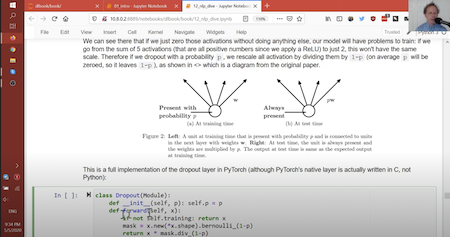
- Dropout is basically deleting activations at random.
- By removing activations at random, no single activations can become too "overspecialised"
- Dropout implementation:
class Dropout(nn.Module):
    def __init__(self, p):
        self.p = p

    def forward(self, x):
        if not self.training:
            return x

        mask = x.new(*x.shape).bernoulli_(1-p)
        return x * mask.div_(1-p)
- A bermoulli random variable is a bunch of 1 and 0s with
1-pprobability of getting a 1.- By multipying that by our input, we end up removing some layers.
01:47:16 - AR and TAR regularisation
- Jeremy has only seen in RNNs.
- AR (for activation regularisation)
- Similar to Weight Decay.
- Rather than adding a multiplier * sum of squares * weights.
- We add multiplier * sum of squares * activations.
- TAR (for temporal activation regularisation).
- TAR is used to calculate the difference of activations between each layer.
01:49:09 - Weight tying
Since predicting the next word is about converting activations to English words.
An embedding is about converting words to activations.
Hypothesis: since they're roughly the same idea, can't they use the same weight matrix?
- Yes! This appears to work in practice.
class LMModel7(Module):
    def __init__(self, vocab_sz, n_hidden, n_layers, p):
        self.i_h = nn.Embedding(vocab_sz, n_hidden)
        self.rnn = nn.LSTM(n_hidden, n_hidden, n_layers, batch_first=True)
        self.drop = nn.Dropout(p)
        self.h_o = nn.Linear(n_hidden, vocab_sz)

        # This new line of code ensures that the weights of the embedding will always be the same as linear weights.
        self.h_o.weight = self.i_h.weight
        self.h = [torch.zeros(n_layers, bs, n_hidden) for _ in range(2)]

    def forward(self, x):
        raw, h = self.rnn(self.i_h(x), self.h)
        out = self.drop(raw)
        self.h = [h_.detach() for h_ in h]
        return self.h_o(out), raw, out

    def reset(self):
        for h in self.h:
            h.zero_()
01:51:00 - TextLearner
- We pass in
RNNRegularizercallback:
learn = Learner(
    dls,
    LMModel7(len(vocab), 64, 2, 0.5),
    loss_func=CrossEntropyLossFlat(),
    metrics=accuracy, cbs=[ModelResetter, RNNRegularizer(alpha=2, beta=1)])
- Or use the
TextLearnerwhich passes it for us:
learn = TextLearner(
    dls,
    LMModel7(len(vocab), 64, 2, 0.5),
    loss_func=CrossEntropyLossFlat(),
    metrics=accuracy
)
learn.fit_one_cycle(15, 1e-2, wd=0.1)
| epoch | train_loss | valid_loss | accuracy | time |
|---|---|---|---|---|
| 0 | 2.583476 | 2.096658 | 0.452637 | 00:01 |
| 1 | 1.619627 | 1.360577 | 0.628581 | 00:01 |
| 2 | 0.874051 | 0.910055 | 0.776449 | 00:01 |
| 3 | 0.441865 | 0.803067 | 0.819824 | 00:02 |
| 4 | 0.226623 | 0.656291 | 0.852620 | 00:01 |
| 5 | 0.127504 | 0.559974 | 0.862549 | 00:01 |
| 6 | 0.077614 | 0.450280 | 0.887614 | 00:01 |
| 7 | 0.056029 | 0.559095 | 0.874430 | 00:02 |
| 8 | 0.038954 | 0.491778 | 0.877441 | 00:02 |
| 9 | 0.030191 | 0.524026 | 0.879964 | 00:01 |
| 10 | 0.024196 | 0.501803 | 0.877767 | 00:01 |
| 11 | 0.020231 | 0.504942 | 0.877686 | 00:01 |
| 12 | 0.016885 | 0.424204 | 0.889811 | 00:01 |
| 13 | 0.014706 | 0.461084 | 0.884603 | 00:01 |
| 14 | 0.013446 | 0.466097 | 0.884603 | 00:01 |
- We've now reproduced everything in AWD LSTM, which was state of the art a few years ago.
01:52:48 - Conclusions
- Go idea to connect with other people in your community or forum who are along the learning journey.