Gemini 4 Argon: Google's long-awaited new frontier model
The model releases keep coming! Today, Google launched its long-awaited new frontier model, Gemini 4 Argon.
It tops most of the benchmarks on Google's own model card (14 of 19), as you'd expect. But Claude Opus 5.5 still leads on terminal coding, and on Artificial Analysis's independent index (GoogleDeepMind, 2026) (ArtificialAnalysis).
Google says it's a brand-new model architecture. Apparently, "not a modification or a fine-tune of a prior model". It's built as a sparse Mixture-of-Experts transformer, but they don't disclose the parameter count (GoogleDeepMind, 2026).
Notably, it can write up to 1M tokens in a single response, which, as far as I can tell, is a first for a publicly available frontier model. However, you need to use the "long decode" background job via the Interactions API, which generates the output in 64K "hops" and joins them together. Without it, the limit is 65,536 (Google) (Google).
Introductory prices are on par with GPT-6 Sol, but after the introductory period, it's basically Claude Opus 5.5 and Muse Wonder prices (Google).
It supports audio and video, plus the usual multimodal suspects. I tested a few things, including video understanding, audio understanding and code generation. Very impressive results (Google).
Specs Argon vs Muse Wonder vs Opus 5.5
| Specification | Gemini 4 Argon | Muse Wonder | Claude Opus 5.5 |
|---|---|---|---|
| API identifier | gemini-4-argon |
muse-wonder-1.0 |
claude-opus-5-5 |
| Input / output | Text, images, video, audio and PDF / text | Text, images, video, audio and PDF / text | Text and images / text |
| Context window | 1,048,576 tokens, input and output combined | 1,048,576 tokens | 1M tokens |
| Maximum output | 65,536 by default, up to 1,048,576 with long decode | Not published | 128K tokens |
| Knowledge cutoff | March 2026 | Not published | June 2026 |
| Effort levels | low, medium, high |
minimal to max |
low to max |
| Status | Stable | Preview | Generally available |
As of 14 October 2026 (Google) (GoogleDeepMind, 2026). Muse Wonder and Opus 5.5 columns as of 13 October 2026, from the Muse Wonder article.
Pricing and Cache Settings
It's half price until the end of November. From 1 December, it doubles to the same price as Opus 5.5 and Muse Wonder.
Prices in USD per million tokens, as of 14 October 2026.
| Usage | Argon, to 30 Nov | Argon, from 1 Dec | Muse Wonder | Claude Opus 5.5 |
|---|---|---|---|---|
| Input, uncached | $2.00 | $4.00 | $4.00 | $4.00 |
| Input, cache read | $0.10 | $0.20 | $0.20 | $0.20 |
| Cache write | No price listed | No price listed | No price listed | $5.00 (5 min), $8.00 (1 hour) |
| Output, including thinking | $10.00 | $20.00 | $20.00 | $20.00 |
| Batch input / output | $1.00 / $5.00 | $2.00 / $10.00 | Not listed | $2.00 / $10.00 |
Gemini pricing from Google (Google); Muse Wonder and Opus 5.5 as of 13 October 2026, from the Muse Wonder article.
There's no free tier and no extra charge for long prompts. Caching happens automatically, like Muse Wonder, so there's no cache write price (Google).
Tokenisers
I counted the tokens in the same six files I used for Muse Wonder.
| Sample | Opus 5.5 | Muse Wonder | Gemini 4 Argon | Opus ÷ Argon |
|---|---|---|---|---|
| Survey summary (prose) | 9,992 | 6,064 | 6,323 | 1.58 |
| AudioLM summary (prose) | 8,024 | 4,946 | 5,072 | 1.58 |
| Ansible tutorial (prose and commands) | 6,086 | 4,109 | 4,337 | 1.40 |
| GPT 6 Sol and Luna article (prose and code) | 13,847 | 8,990 | 10,411 | 1.33 |
| Python rendering script | 15,708 | 10,119 | 12,199 | 1.29 |
| Generated HTML game | 11,393 | 7,762 | 9,242 | 1.23 |
For prose, Argon uses about the same number of tokens as Muse Wonder. For code and HTML, it uses a bit more (16 to 21%). Both are well ahead of Opus, which needs 1.2 to 1.6 times as many tokens for the same text.
Cost Per Task
Artificial Analysis tested all three on its Intelligence Index (ArtificialAnalysis) (ArtificialAnalysis) (ArtificialAnalysis):
| Gemini 4 Argon (high) | Muse Wonder (max) | Claude Opus 5.5 (max) | |
|---|---|---|---|
| Intelligence Index v4.3 | 53 | 52 | 58 |
| Output tokens used | 110M | 130M | 260M |
| Cost per index task | $1.99 | $4.52 | $5.98 |
Argon is by far the cheapest per task, but that's at the launch price. From December, it'd be about $4 a task, roughly the same as Muse Wonder. Argon only goes up to high effort, while the other two ran at max.
Benchmarks
Google compares Argon with Opus 5.5, Claude Fable 5.1 and GPT-6 Astra. Here are some of the results (GoogleDeepMind, 2026):
| Benchmark | Gemini 4 Argon | Opus 5.5 | Fable 5.1 | GPT-6 Astra |
|---|---|---|---|---|
| Vals Index | 68.9 | 67.0 | 65.8 | 63.1 |
| Harvey's Legal Agent Benchmark | 19.6 | 3.8 | 6.7 | 5.4 |
| AutomationBench | 51.3 | 42.5 | 31.4 | 41.4 |
| DeepSWE v1.1 | 77.9 | 74.2 | 67.4 | 74.1 |
| Terminal-Bench 4.0 | 57.4 | 66.4 | 57.9 | 58.2 |
| PostTrainBench | 45.3 | 49.3 | 40.2 | 44.3 |
| GraphWalks BFS, 256K to 1M (F1) | 84.2 | 66.8 | 65.0 | 71.8 |
| LVBench (long video) | 91.7 | 83.7 | 79.7 | 87.5 |
| CWE-bench v1 | 68.0 | 67.0 | 58.0 | 68.0 |
Argon comes top on 14 of Google's 19 benchmarks, with the biggest wins on very long context (GraphWalks, 256K to 1M tokens) and legal work. Opus 5.5 still wins on terminal coding and PostTrainBench, and GPT-6 Astra wins three, including OSWorld-2.0 (GoogleDeepMind, 2026).
Google doesn't compare it with Muse Wonder, and the two model cards mostly use different benchmarks. The one they share is DeepSWE, where Muse Wonder (78.8) just beats Argon (77.9) (Meta, 2026).
Safety
Two things stood out to me in the model card.
First, it refuses less. Google says it wrongly refuses harmless or borderline prompts 9.6 percentage points less often than Gemini 3.1 Pro (GoogleDeepMind, 2026), and "answers questions more directly with less hedging" (Kavukcuoglu, 2026).
Second, Google say they can't rule out that Argon could give meaningful help to someone trying to cause harm with biological weapons or cyberattacks, so it shipped with extra safeguards. It also passed 14 of 15 of Google's tests of stealth and situational awareness, which check whether a model could get around oversight (GoogleDeepMind, 2026).
Drawing SVGs
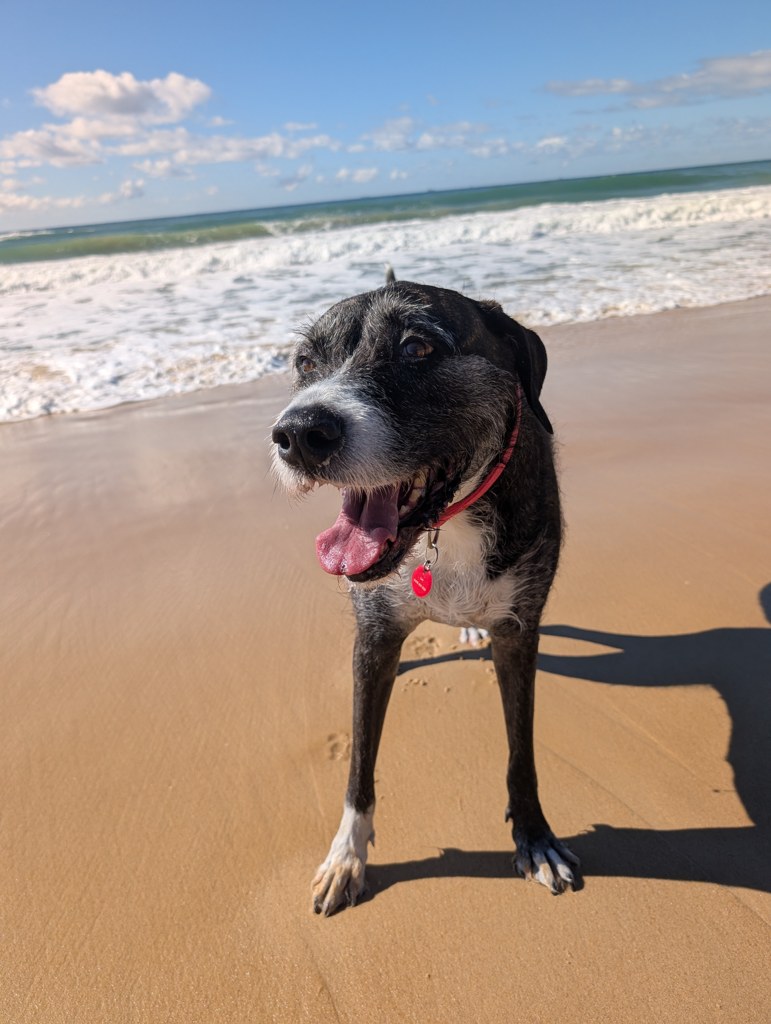
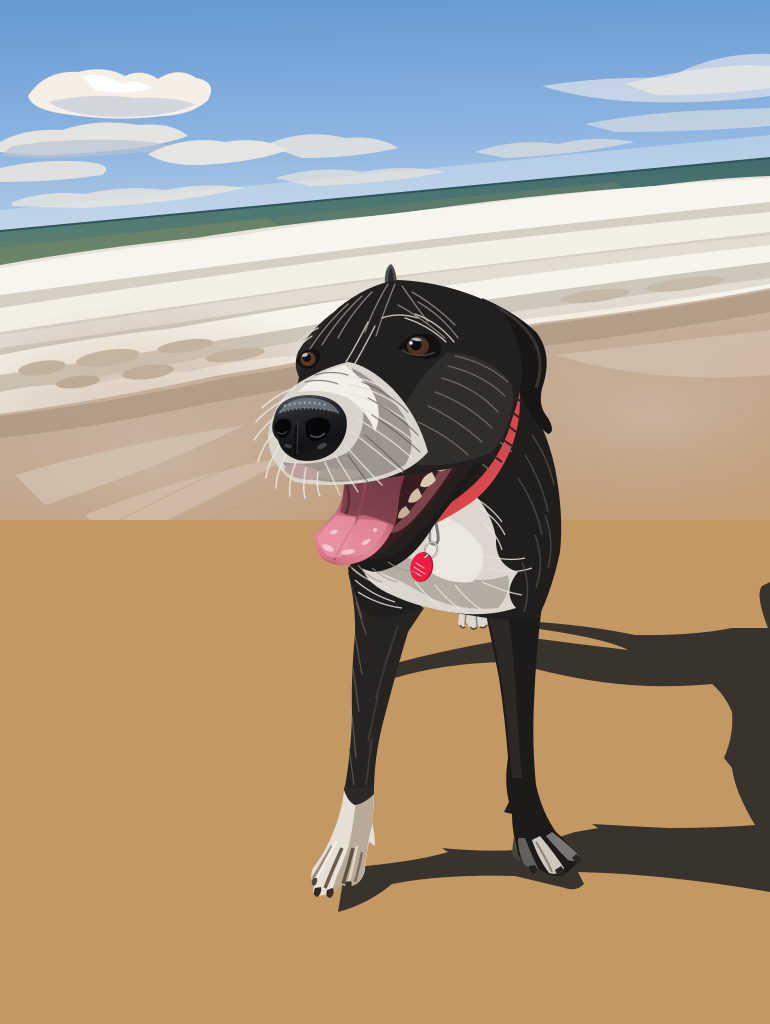
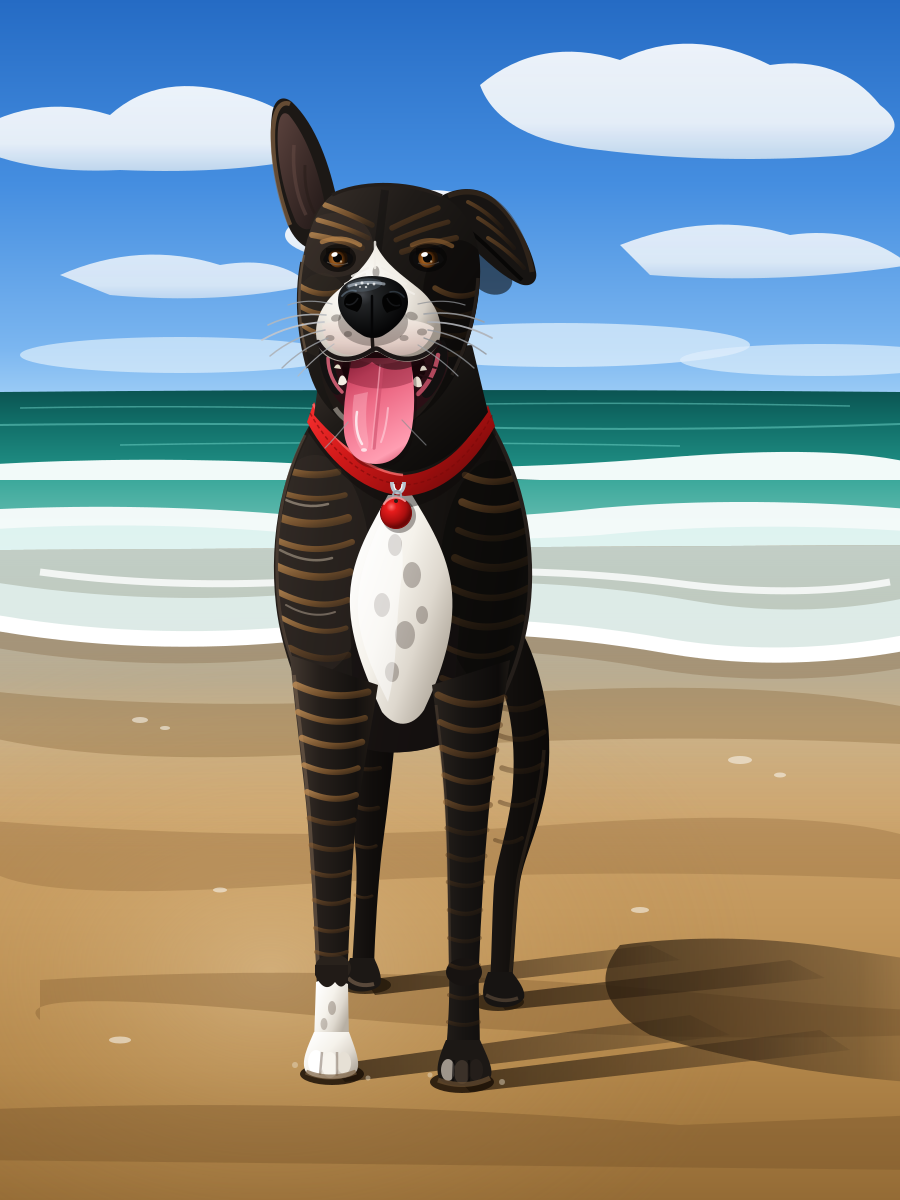
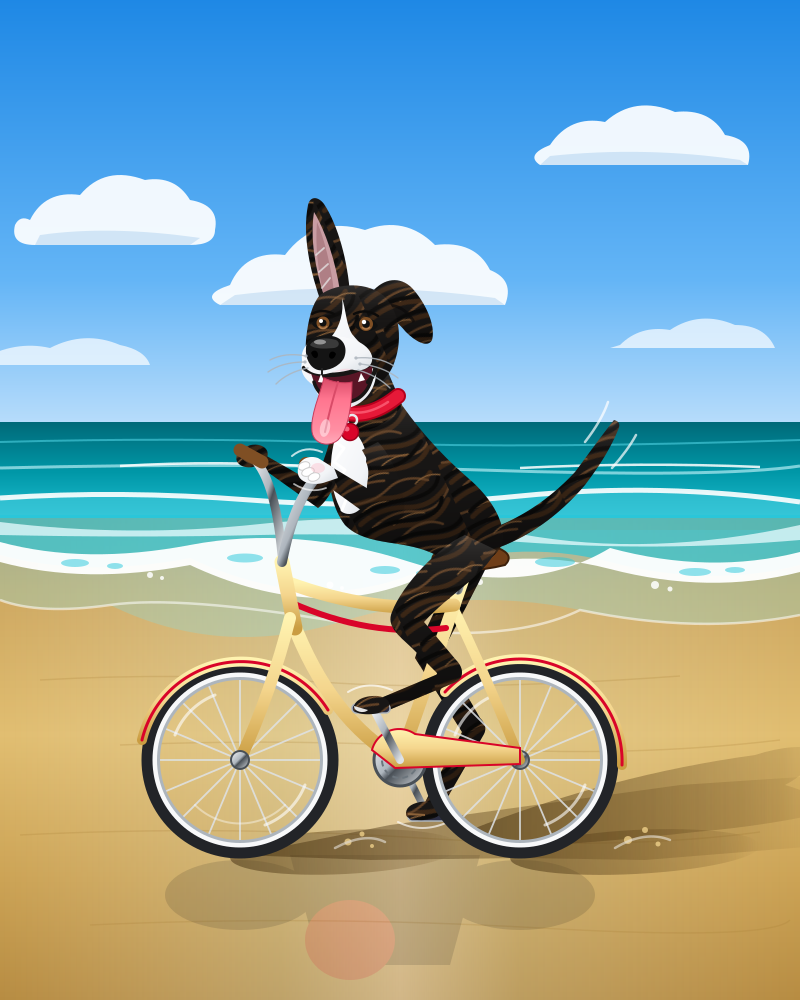
People on Hacker News have been impressed by Argon's SVG drawings, so I tried it on a photo of my dog at the beach.
I sent it the photo and asked it to "Recreate this photo as an SVG, as close to the original as you can." Then, to see how it draws without seeing anything, I had Claude write a short description of the photo, added her breed and colouring, and sent only the text. And finally, in honour of Simon Willison's pelican riding a bicycle test, I asked it to "Generate an SVG of this dog riding a bicycle", with the same description.
The text description
A portrait-orientation photo of a black brindle Bull Arab and Staghound cross standing on wet golden sand at the beach on a sunny day. The dog faces the camera, with its head turned slightly towards the left of the frame. It has a white muzzle and grey whiskers, a big black nose, brown eyes, one ear pricked up and one flopped over, and its mouth is open in a happy pant with a long pink tongue hanging out. It wears a red collar with a small round red tag, and has a white patch on its chest. Its legs are long and thin, the front-left paw is white, and the paws are slightly blurred. Its shadow stretches away to the right across the sand. Behind it, white foamy waves wash up the shore, then a band of teal-green sea meets a bright blue sky with scattered white clouds.
All three used high thinking, took 4 to 5 minutes, and cost US$0.20 to $0.30 each (raw results).
Pretty, pretty good.
Testing the audio
I ran the same two audio tests as in the Muse Wonder article, with the same clips and prompts.
Classifying sounds
Argon got 20 of the 25 ESC-50 sound clips right, the same as Muse Wonder, but it missed different ones (Piczak, 2015):
| Clip | Argon's answer | Muse Wonder's answer |
|---|---|---|
| Rain | Clapping ✗ | Rain ✓ |
| Wind | Helicopter ✗ | Sea waves ✗ |
| Toilet flush | Pouring water ✗ | Toilet flush ✓ |
| Siren | Crying baby ✗ | Siren ✓ |
| Fireworks | Thunderstorm ✗ | Fireworks ✓ |
| Snoring | Snoring ✓ | Dog ✗ |
| Keyboard typing | Keyboard typing ✓ | Dog ✗ |
| Helicopter | Helicopter ✓ | Rain ✗ |
| Church bells | Church bells ✓ | Dog ✗ |
Its misses sound like genuine mishearings. It heard the rain clip as "a large crowd of people clapping" every time, and the siren as a wind instrument or a kazoo.
The surprise was silence. I sent five seconds of nothing, three times, and Argon heard "someone blows into a harmonica", then "a young man speaks in a calm and gentle tone, accompanied by the sounds of keyboard typing", then a man talking over a car engine and horn. Muse Wonder just said no recording was attached.
It was also much cheaper and faster. Argon barely thought at its default setting, so each clip took about 4.5 seconds, and all 25 cost about US$0.02, against US$0.69 for Muse Wonder (raw results).
Transcribing two speakers
I sent the same 75-second clip of two podcast hosts and asked for a transcript with a line for each speaker.
Argon was basically perfect, getting one word wrong in each run. It even caught a quiet "Right, yeah" and an "um" that WhisperX missed. Its one mistake was the same word Muse Wonder struggled with, which might just be a stutter in the audio. Each run cost under a cent (raw results).
Testing video
I also sent two of my own phone videos and asked each question three times.
The exercise answers all followed the same rep-by-rep template, ending with "The user successfully performed 3 completed reps", so I suspect Google trained it on workout videos.
All 12 questions cost about US$0.03 (raw results).
Real example
As with Muse Wonder and Claude Opus 5.5, I asked Argon to turn this article into a 3D gameshow that looks like an N64 game.
This uses Google's Gen AI Python SDK, and my Notebook HTML helper saves and shows the game:
pip install google-genai ./notesbylex_notebook_html-0.1.3-py3-none-any.whl
Set GEMINI_API_KEY in the environment used to launch Obsidian. Running the cell costs money, but the saved game plays for free.
from google import genai
from google.genai import types
from notebook_html import read_article, render_gemini_html

client = genai.Client()
article = read_article("gemini-4-argon.md", before="Real example")
stream = client.models.generate_content_stream(
    model="gemini-4-argon",
    config=types.GenerateContentConfig(
        system_instruction="Return a complete, self-contained HTML document.",
        thinking_config=types.ThinkingConfig(thinking_level="high"),
        max_output_tokens=65_536,
    ),
    contents=f"""
Turn this article into a 3D gameshow that looks like an N64 game.
Use around 8 questions that test understanding of the article, with a short
explanation after each answer.
Support phones and keyboards. Use inline CSS and JavaScript, no external assets,
network requests or browser storage, and no em dashes. Keep the code compact,
with one shared question renderer.

Article:
{article}
""",
)
render_gemini_html(stream, "../_media/gemini-4-argon-quiz-high.html")
It used high thinking and cost about US$0.17 at the launch price (saved token usage) (Google):
| Usage | Tokens | Cost, launch price (USD) | Cost from 1 December (USD) |
|---|---|---|---|
| Input, uncached | 2,631 | $0.0053 | $0.0105 |
| Output, including thinking | 16,862 | $0.1686 | $0.3372 |
| Total | 19,493 | $0.1739 | $0.3477 |
Of the output tokens, 2,622 were thinking and 14,240 were the game itself, about three times the size of Muse Wonder's.
For comparison, Claude Opus 5.5 used 49,136 tokens (US$0.96) and Muse Wonder used 7,693 (US$0.12). Argon thought less than either but wrote a much bigger game.
I made the game from an earlier draft of this article, before the SVG, audio and video sections.
It looks like a proper N64 game, with a blocky robot host, spinning stars and a pixelated stage. Everything I tried worked, on desktop and phone. It's just one small coding example, though, not a benchmark.
Play the game in its own page.
References
Koray Kavukcuoglu. Gemini 4 Argon: built to solve your hardest problems. 2026. Google blog, published 13 October 2026. Accessed 14 October 2026. URL: https://blog.google/innovation-and-ai/models-and-research/gemini-models/introducing-gemini-4-argon/ (visited on 2026-10-14). ↩
Karol J. Piczak. ESC: dataset for environmental sound classification. In Proceedings of the 23rd Annual ACM Conference on Multimedia, 1015–1018. ACM, 2015. Dataset licensed CC BY-NC 3.0; clips from Freesound. URL: https://github.com/karolpiczak/ESC-50, doi:10.1145/2733373.2806390. ↩
Artificial Analysis. Claude opus 5.5 (max): intelligence, performance and price analysis. Living leaderboard. Accessed 13 October 2026. URL: https://artificialanalysis.ai/models/claude-opus-5-5 (visited on 2026-10-13). ↩
Artificial Analysis. Gemini 4 argon (high): intelligence, performance and price analysis. Living leaderboard. Accessed 14 October 2026. URL: https://artificialanalysis.ai/models/gemini-4-argon (visited on 2026-10-14). ↩ 1 2
Artificial Analysis. Muse wonder (max): intelligence, performance and price analysis. Living leaderboard. Accessed 13 October 2026. URL: https://artificialanalysis.ai/models/muse-wonder (visited on 2026-10-13). ↩
Google DeepMind. Gemini 4 Argon model card. 2026. Published October 2026. Accessed 14 October 2026. URL: https://deepmind.google/models/model-cards/gemini-4-argon/ (visited on 2026-10-14). ↩ 1 2 3 4 5 6 7
Google. Long decode. Gemini API documentation. Living documentation. Accessed 14 October 2026. URL: https://ai.google.dev/gemini-api/docs/long-decode (visited on 2026-10-14). ↩
Google. Gemini 4 Argon. Gemini API documentation. Living documentation. Accessed 14 October 2026. URL: https://ai.google.dev/gemini-api/docs/models/gemini-4-argon (visited on 2026-10-14). ↩ 1 2 3
Google. Gemini developer API pricing. Living documentation. Accessed 14 October 2026. URL: https://ai.google.dev/gemini-api/docs/pricing (visited on 2026-10-14). ↩ 1 2 3 4
Meta. Muse wonder model card. 2026. Released 12 October 2026. Accessed 13 October 2026. URL: https://research.meta.ai/static/muse-wonder-model-card (visited on 2026-10-13). ↩
Comments
Reply to this post on Bluesky or Mastodon to join the conversation.