Improving Deep Neural Networks: - Week 2
Week 2
Mini-batch gradient descent
- Gradient descent requires you to process your entire training dataset to make a step.
- Mini-batch takes a portion of the dataset and runs forward/backprop on it.
- Speeds up training time.
Understanding mini-batch gradient descent
- The cost should decrease on every iteration of gradient descent.
- Mini-batch would normally be more noisy but should trend downwards.
- Mini-batch parameter becomes a new parameter to choose.
- When set to , it's batch gradient descent (or just standard gradient descent).
- When set to 1, it's considered "stochastic gradient descent".
- Stochastic gradient descent can be very noisy and won't ever converge.
- Mini-batch is somewhere in between 1 and : optimal should work faster overall.
- Batch gradient descent can be slow per iteration.
- Stochastic is fast per iteration but can take longer to find a good result.
- Guidelines for choosing mini-batch size:
- Use gradient descent if you have a small training dataset (< 2k).
- Typical mini-batch sizes: 64 up to 512.
- Code will sometimes run faster if mini-batch size if power of 2 (really tho?).
- Want to make sure mini-batch fits in GPU/CPU memory.
Exponentially weighted averages
- Aka exponentially weighted moving averages.
-
If you had a bunch of variables that assigned a day to a temperature:
day[1] = 4 day[2] = 5 ... day[180] = 29 day[181] = 31- You could compute the moving average as follows:
day[0] = 0
day[1] = 0.9 * day[0] + 0.1 * day[1]
day[2] = 0.9 * day[1] + 0.1 * day[2]
- You could compute the moving average as follows:
-
General formula: or in code:
day[x] = 0.9 * day[x-1] + 0.1 * day[x] -
Even more generally:
- In the above example we set beta as follows:
-
Creates a line through the data that's much smoother but the curve shifts a bit to the right. So you have some latency when the weather changes:
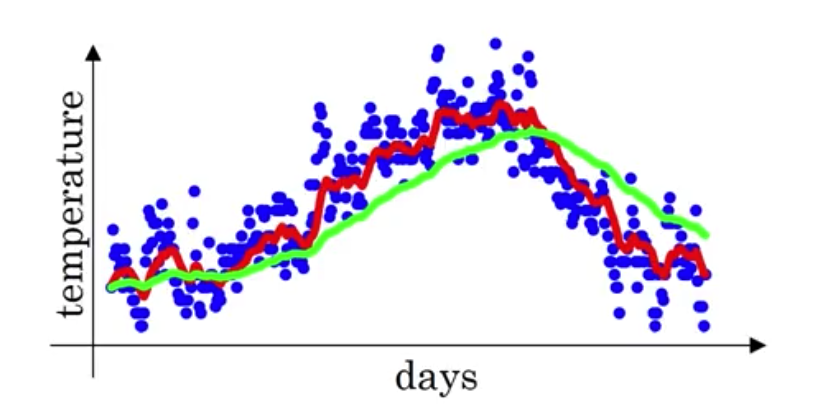
- The higher you set beta, the more latency you have and the more days you would be averaging over, in the example.