Week 5 - Recommending Products
- Recommender systems in action
- "Personalization"
- Netflix: product recommendations
- Pandora
- Facebook friend recommendations
- Drug-target interactions
- Building recommender with classification
- Popularity
- What are people viewing now?
- Pros:
- Rudimentary solution to the "cold-start problem": what to show the user when you know nothing about them.
- Limitations:
- No personalization
- Classification model (like sentiment analysis)
- Considered supervised learning (?).
- Potential features:
- User info.
- Purchase history.
- Product info.
- Other info.
- Classifier takes features as input and return the probability of buying the product
- Pros:
- Personalized: considers user info etc
- Features can capture context: time of day, what user just saw
- Handles limited user history: age of user etc.
- Cons:
- Quality of information may be low.
- Features may not be available (might not know age etc).
- Doesn't work as well as "collaborative filtering"
- Popularity
-
Collaborative filtering
- "People who bought x also bought y."
-
Requires co-occurrence matrix:
- Store # users who bought both items i & j
-
In code:
purchased_items_pos = ['Nike Air', 'Reebook Pump', 'Mercedes Pumas'] purchases_also_made['Nike Air'] = [53, 2, 3] purchases_also_made['Reebook Pump'] = [2, 22, 6] purchases_also_made['Mercedes Pumas] = [3, 6, 100] -
Considered a "symmetric" matrix because
matrix['Nike Air']['Mercedes Pumas'] == matrix['Mercedes Pumas']['Nike Air']- "Number of users who bought Nike Airs and Mercedes Pumas is the same as users who bought a Mercedes Pumas and Nike Airs."
- How it would be used:
- "Number of users who bought Nike Airs and Mercedes Pumas is the same as users who bought a Mercedes Pumas and Nike Airs."
-
User buys Nike Airs.
- Sort the Nike Airs row by "also made" purchases and display the top few.
recommended = sorted(purchases_also_made['Nike Air'])[:recommendation_count]
-
Need to normalize co-occurrence matrix
- Very popular items "drowns out" other items.
- One strategy: "Jaccard similarity"
-
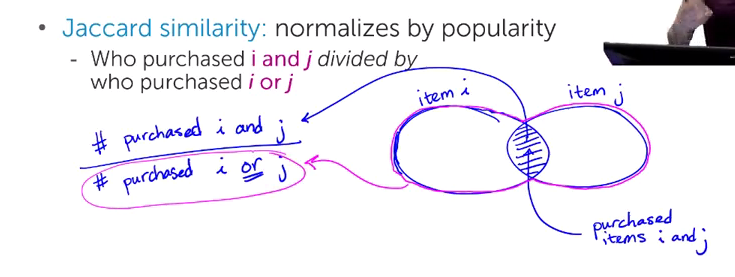
"Jaccard similarity"
-
Normalize by popularity.
-
Overview:
- Count people who purchased i and j
- Count people who bought i or j
- Divide 1 by 2
-
In code:
purchased_i.union(purchased_j) / purchased_i.intersection(purchased_j) -
Limitations:
- Doesn't factor in purchase history, only looks at current item.
- Solution: "weighed average of purchased items".
- Doesn't factor in purchase history, only looks at current item.
- Weighted average of purchased items
- For all potential recommendable products, go through and calculate similarity score based on each of user's purchase history (maybe weigh recent purchases higher).
-
In code:
user_inventory = {'book', 'hat', 'shoe'} for product in potential_recommendations_in_inventory: score[product] = average([some_similarity_score(p) for p in user_inventory]) highest_j = sort(score) -
Limitations:
- Doesn't use a variety of available features:
- Context
- User features
- Product features
- "Cold start problem" - dealing with user's with no purchase history.
-
Discovering hidden structure by matrix factorization
-
Matrix of movies x users:
movie_pos = ['Taxi Driver', 'Goodfellas', 'Casino'] rating['John'] = [None, 8, 6 ] rating['Bill'] = [3, 3, 5 ] rating['Bob'] = [7, 2, None ] -
Attempt to fill in unrated movies with user's ratings and rating of other users.
- Point: guess the rating a user would give to movies they haven't seen.
-
Overview:
-
Describe movie
vwith topicsR(v): how much action, romance, drama:movie_genres = ['action', 'romance', 'drama'] movie_genres_amount['Taxi Driver'] = [0.3, 0.1, 0.5] # R(v) movie_genres_amount['Goodfellas'] = [0.2, 0.1, 0.7] # R(v) -
Describe how much user
uwith topicsL(u).user_genres_prefered['John'] = [2.5, 0, 0.9] # L(u) user_genres_prefered['Bill'] = [5, 2, 10] # L(u) -
Rating(u, v)is the product of two vectors:ratings = lambda u, v: sum([x * y for x, y in zip(user_genres_prefered, movie_genres_amount)]) -
Sort movies by
Rating(u, v)
-
-
Predictions in matrix form
- Looking at score for
Rating(u, v)==<Lu, Rv>< element-wise product and sum. -
Can get the
uth from theLmatrix row and multiple by thevth row from theRmatrix column.
- Looking at score for
-
Discovering hidden structure by matrix factorization
- Using only observed rating (black squares), we want to estimate L and R matrices.
-
Look at predictions compared to actual observed rating (similar to Regression):
RSS(L, R) = (Rating(u, v) - <Lu, Rv>) ** 2 + sum([(u_prime, v_prime) for pairs if Rating(u_prime, v_prime) -
Reason called a "Matrix Factorization Model" because taking matrix and approximating with factorization.
- Many efficient algorithms for factorization.
- Limitations:
- Cold start problem: new user or new movies (no ratings).
- Featurized matrix factorization
- Features capture context
- Time of day
- What I just saw
- User info
- Past purchases
- Discovered topics from matrix factorization capture "groups of users" who behave similarly.
- Women from Seattle who teach and have a baby.
- Combine to mitigate cold-start problem
- Ratings for a new user from features only.
- As more information about user is discovered, matrix factorization topics become more relevant.
- "Blending models"
- Winning team of Netflix prize blended over 100 models.
- Performance metric for recommender systems
-
Classification accurary
-
Problems:
- Major class: recommend no items.
- Can only get a limited subset of correctly classified items, since user has limited attention.
-
Solution:
- Metrics called "Precision" and "Recall".
-
-
Recall
- Find all liked and figure out how many were recommended.
- Formula:
liked_and_shown / likeditems_recommended = set(['Shoes', 'Jeans', 'Hat', 'Pants']) items_liked = set(['Jeans', 'Hat', 'Glasses']) recall = len(items_recommended.intersection(items_liked)) / len(items_liked) # 2 / 3
-
Precision
- Get all recommended items and figure out how many were liked.
- Formula:
liked_and_shown / shownprecision = len(items_recommended.intersection(items_liked)) / len(items_recommended) # 2 / 4
-
Optimal recommenders
- "How do you maximise recall?" - just recommend everything.
- Small precision.
- What is optimal recommender:
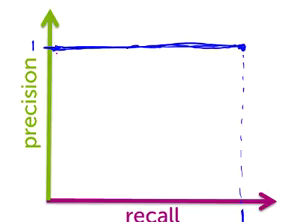
- Recall = 1 (everything liked was recommended).
- Precision = 1 (everything recommended was liked).
- "How do you maximise recall?" - just recommend everything.
-
Precision-recall curve
- Input: a specific recommender system
- Output: Algorithm-specific precision-recall curve
-
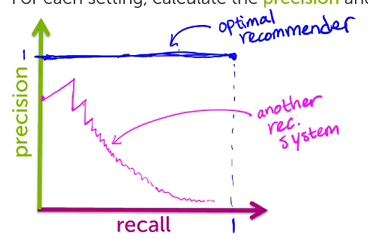
Optimal recommender precision / recall curve:
-
Realistic recommender:
-
Comparing algorithms:
- Largest "area under the curve" (AUC).
- Set desired recall and maximise precision (precision at k).
- Recommender systems ML block diagram
- Training data: user, products, ratings table
- Feature extraction:
- (user_id, product_id).
- Also may include other features like gender, age, product description etc.
- Goal (y-hat): predicted rating for user, product pair.
- Model: matrix factorization.
- Set of features for every user (how much user likes action, comedy etc).
- Set of features for every product (how much a movie action, comedy etc).
- Quality metric:
- RSS (compare error between predicted ratings and observed values).