Week 6 - Deep Learning: Searching for Images
-
Neural networks
-
Represent classifiers using graphs.
-
Allows for complex, non-linear features.
-
-
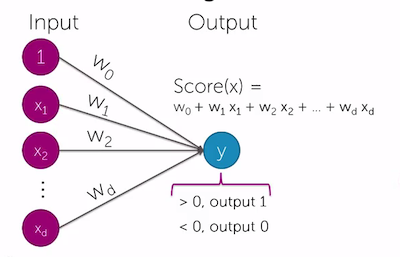
X[]- represents features. W[]- represents weights.W0- not multiplied by any feature, gets multiplied by1(I guess it's a kinda "hard coded" part of the equation).- One layer neural network:
- Basically the same as a linear classifier:
- Creates a linear decision boundary between classifications.
- Can represent:
X[1] OR X[2],X[1] AND X[2] - Can't represent XOR functions.
- XOR problem can be solved by adding a layer.
- Video missing... guess I'll never know...
- Application of deep learning to computer vision
- Image features
- Features == local detectors
- Nose detector, eye detector
- Combined to make prediction.
- In reality, features are more low-level.
- Collections of locally interesting points
- Combined to build classifiers
- Standard approach (without neural networks):
- Basically had to build by hand.
- Extract features from input (similar to extracting features from documents).
- Feed to simple classifier (logistic regression, SVMs).
- Deep learning: implicity earns features
- Multiple layers.
- Different features are captured at different levels.
- Deep learning performance
- SuperVision winning ImageNet in 2012 was a turning point in computer image recognition.
- Other examples of deep learning in computer vision
- "Scene parsing" - figuring out what stuff is in a picture.
- Retrieving similar images: take input image and output nearest neighbour.
- Pros of Neural Networks
- Enables learning of features rather than hand tuning.
- Impressive performance gains
- Computer vision
- Speech recognition
- Some text analysis
- Potential for more impact
- Cons
- Requires lots of high-quality, labeled data
- Lots of complexity
- Computationally expensive
- Hard to tune
- Deep features
- Let's you build neural networks without a lot of data.
- "Transfer learning"
- Use data from one task to learn another
- Take features from experiment to aid another.
- Use the layers in neural net that make sense for dataset, and use simple classifier for the layers that do not.
- Eg Layer 1 and Layer 2 for an algorithm for detecting butterflies could be use for algorithm to detect moths.
-