Essense of linear algebra
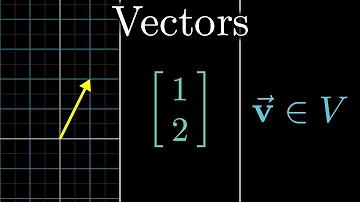
Notes from 3Blue1Brown video Vectors from the Essence of linear algebra series.
Vectors are the building block of linear algebra.
3 perspectives of vectors:
- Physics student
- Vectors are arrows pointing in space defined by length & direction.
- You can move a vector around and it remains the same vector.
- If the space is a flat plane, it's a 2d vector.
- Computer scientist (or data scientist)
- An orderer list of numbers.
- Example, a house can be model as the vector:
[square footage, sale price]
- Mathematician
- A vector can be anything that has a notion of adding two together and multiplying a vector by a number.
- In Linear Algebra, the vector is nearly always rooted at the Origin, which is the place where x and y intersect on the coordinate system.
- Note how it differs from physics student's perspective that can consider a vector at any point in space.
- The "back and forth" between the physics and computer science student understanding of vectors is that we represent coordinates for a line as lists of numbers.
-
2d coordinate system refresher
- Has a horizontal line called the x-axis
- Have a vertical line called the y-axis
-
Place where they intersect is called the Origin
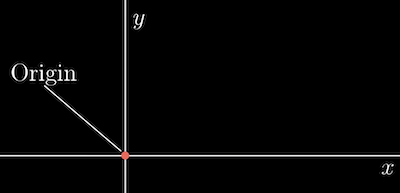
- Can be thought of as the center of space and root of all vectors.
- An arbitrary length is chosen to represent one, then tick marks are created on each axis spaced at this distance
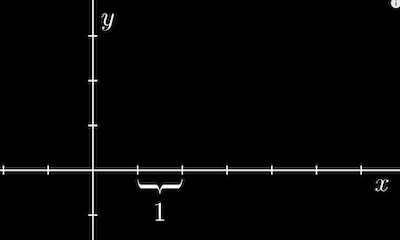
- Can be thought of as the center of space and root of all vectors.
-
Coordinates of vector give instructions to get from the Origin to its tip
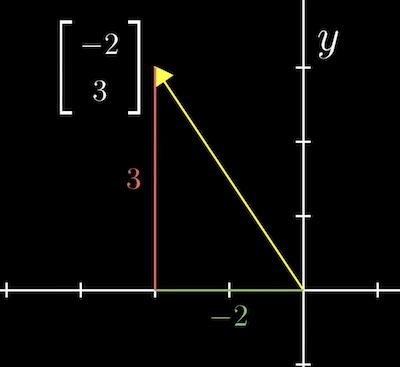
- The first number describes how far to walk along the x-axis.
- The second number describes how far along the y-axis.
-
We distinguish vectors from points by writing them vertically using square bracket notation.
-
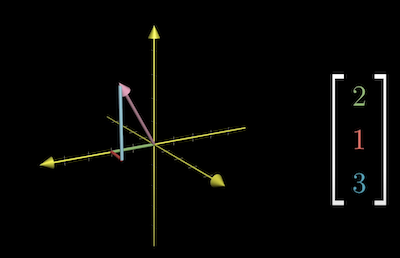
In 3d, an additional axis is drawn that's perpendicular to the other axes, adding a 3rd coordinate
-
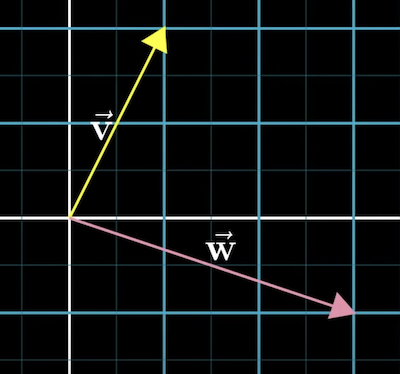
Vector addition from the physics perspective:
-
First draw both vectors:
-
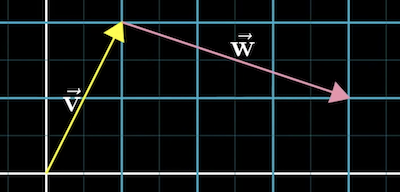
Move the 2nd vector up to the tip of the tail of the first vector:
-
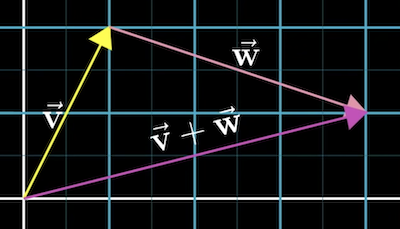
Draw a new vector that starts from the tail of the first to the tip of the 2nd. The new vector represents the sum of 2 vectors.
-
-
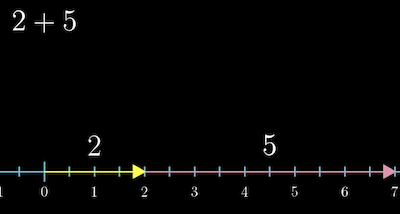
The above definition of vector addition is an extension to how we teach kids to add numbers using the number line: we start at a number, then step in the direction of the number we're adding.
-
The same operation written from the computer scientist perspective:
-
Vector multiplication is when you multiply a vector by a number (Vector Scaling) either stretching or squishing the vector by that amount.
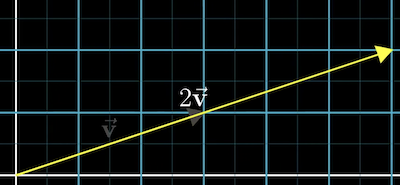
- Referred to as "scaling the vector," hence the number in this context is called a "scalar."
-
Computer science perspective: