The downsides to fitness tracking rings
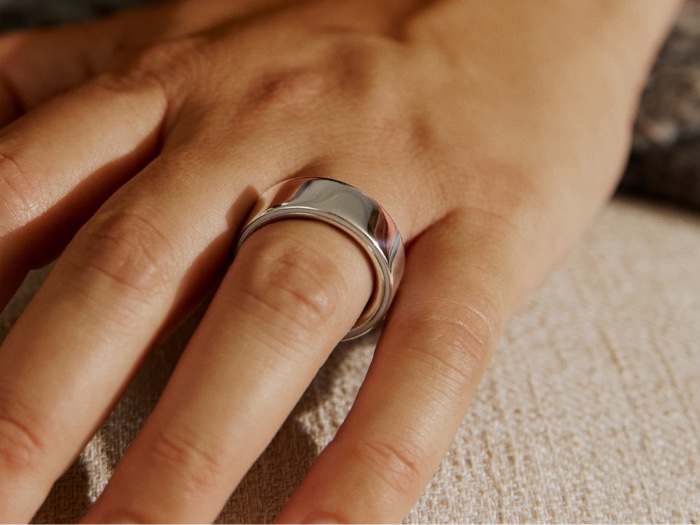
After about a year of wearing a fitness-tracking ring, I've decided to throw in the towel and switch to a wrist device, namely, the Google Fitbit Air.
I've never been big on wearing watches - no reason in particular. I just never really got into them, since mobile phones have kept the time for most of my adult life. But I already wear a wedding ring. So when looking for a fitness and sleep-tracking device, I thought a fitness ring was going to be a natural fit, and hey, they look kinda cool.
But there are a few major downsides to fitness rings that I hadn't considered when I purchased mine, which are now blatantly obvious.
1. Rings are not adjustable
Turns out your fingers store quite a bit of fat, and if you successfully use the fitness-tracking device to lose weight, well, it's very possible that the ring won't fit you anymore. I initially bought an Oura size 13 when I was around 94 kg. I lost about 14 kg and found that the Oura didn't fit. After picking up a new sizing kit, I was down to a size 11.
Not only that, your fingers change size with temperature. Cooler temperatures tend to make your fingers look smaller, while warmer temperatures do the opposite. Oura's own product guidance says that finger size also fluctuates with food and drink, exercise and altitude.
2. You have to take them off to lift weights
Many exercises, from pull-ups to the bench press, place the ring between your hand and a metal bar. Oura recommends removing the ring during activities that involve friction, including weightlifting, to avoid scratches. For many people, this means the ring itself cannot track the very workouts they bought it for.
3. They get in the way, a lot
Rings are constantly exposed while washing your hands, showering, cleaning and gripping things. Even when the ring is water-resistant, water and soap can become trapped underneath it, so removing, drying and replacing it becomes another small source of daily friction. The outer surface is also easy to scratch. Oura's care instructions acknowledge both trapped moisture and scratching.
On the plus side, they are pretty good at tracking sleep. A 2024 study comparing the Oura Ring Gen3, Fitbit Sense 2 and Apple Watch Series 8 against polysomnography found that all three were good at distinguishing sleep from wake. Oura agreed with the sleep lab for 92% of those measurements, compared with 91% for Fitbit and 93% for Apple. For specific sleep stages, Oura's overall agreement was 76.3%, compared with 70.9% for Fitbit and 75% for Apple.
There are important caveats. This was a one-night study with 35 healthy adults. The Oura results were better for the group than for predicting an individual's deep and REM sleep totals, and Oura funded the study.
Heart rate
Oura also performs well when you're asleep and still. A 2022 study of 35 people found that its overnight heart rate readings closely matched a medical-grade ECG, with a mean bias of less than 1 beat per minute.
The story changes once you start moving. A 2026 independent study of nine wrist wearables and the Oura Ring Gen3 found that Oura had a median heart-rate error of 11 beats per minute across rest, stress and walking, compared with 4.5 for the Fitbit Charge 6 and 4.9 for the Google Pixel Watch 2. The study tested only 10 people per device and did not include high-intensity exercise or weightlifting. Still, it supports the idea that Oura's daytime heart rate tracking can be less accurate than that of a good wrist device.
Steps
Step counts are more mixed. In a 14-day study of 32 people, Oura's daily step counts correlated strongly with those of the reference device, with a mean absolute percentage error of less than .10% Still, it overcounted by an average of 2,124 steps per day. Another study comparing an Oura Gen2 and Polar Vantage watch found that both correlated similarly with a research-grade ActiGraph, although neither was accurate enough to replace it.
So fitness rings are not generally less accurate than watches. Sleep and overnight heart rate are strengths, while step counts are rough estimates on both types of devices. Daytime heart rate is the weak point, as research supports. And if, like me, you need to remove the ring whenever you lift weights, its theoretical accuracy hardly matters. It isn't collecting anything.
References
- Robbins et al., Accuracy of Three Commercial Wearable Devices for Sleep Tracking in Healthy Adults, 2024.
- Cao et al., Accuracy Assessment of Oura Ring Nocturnal Heart Rate and Heart Rate Variability in Comparison With Electrocardiography, 2022.
- Gielen et al., Accuracy of Optical Heart Rate Measurements for 10 Commercial Wearables in Different Climate Conditions and Activities, 2026.
- Kristiansson et al., Validation of Oura Ring Energy Expenditure and Steps in Laboratory and Free-Living, 2023.
- Henriksen et al., Polar Vantage and Oura Physical Activity and Sleep Trackers: Validation and Comparison Study, 2022.